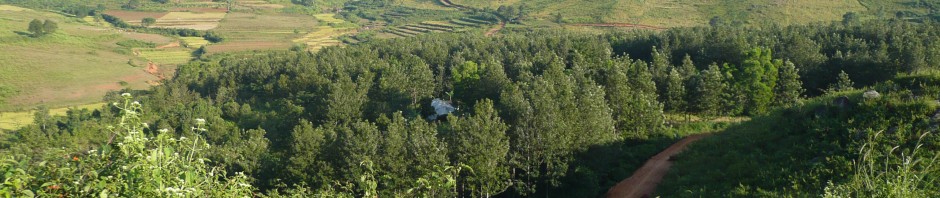
The big surprise at the beginning of the year was a coffee harvest [in the 3 plantations] that exceeded all previous expectations. The total crop was 2000 kilograms of coffee – 2 metric tons, which were harvested even though one of the three plantations was attacked by coffee leaf rust. This rust required 60% of the trees to be “set to the trunk” (German: “auf den Stock setzen”), a procedure which involves cutting off all of a tree’s branches and waiting until the trunk grows healthy ones. So we managed to bring in this harvest in the other 2 plantations alone.
In the past, we dried the coffee after picking it and offered it to private buyers. The proceeds from these sales were 1 euro per kg.
Given the size of this year’s harvest, we have begun to consider improving the cultivation of the coffee-crop cultivation and processing the crop on-site in order to market the product directly in Germany.
During a visit to a small roasting facility in Heimerzheim near Bonn, I learned about a dedicated and laborious procedure that is applied to robustacoffee – the same coffee that we grow – to produce a truly exceptional coffee. The name of this coffee is Cafe Casolo. The roaster, Peter Winkler, also procures his coffee in India, and initiated us into all of the secrets of refinement and roasting.
Caffè Casolo peterwinkler@emport.eu Informationen auch: www.emiko.de
As a result of this experience, I became persuaded of the feasibility of a commercial partnership between small coffee-farmers in Orissa and independent roasteries in Germany, a partnership which would raise proceeds for our farmers. Apart from the 3 plantations, we have now also been approached by individual farmers who would like to plant coffee trees in their gardens or in the bush. We will support them with plants and “know-how” and allow them to participate in our local German marketing project.
To make that project succeed, we need to achieve two standards of quality.
In the next few years, we will need to adopt methods of cultivation that are certifiably organic. What specific methods we will adopt is still undecided; but we are currently investigating an international program for organic cultivation known as “permaculture.”
The second standard we will need to achieve involves how the fruit is picked. On large planations, such as those in Brasil, the fruit is picked mechanically – and, as a result, all the fruit is harvested simultaneously irrespective of the stage of ripeness.
In order to produce good coffee, it is essential to harvest the fruit when it is ripe and red, which can only be accomplished by hand-picking the fruit and by undertaking multiple sweeps of the crop. Hand-picking is a procedure that we take for granted. The challenge for us is split our harvest into multiple sweeps, with the goal of harvesting ripe fruits only.
In addition, direct marketing to local roasteries will require us to remove the skin of the coffee-berry on-site. To this end, all three plantations will receive a machine with a hand-crank, a so-called “pulper.” In a process known as “wet-processing,” the farmers will use this machine to separate the fresh coffee-berry from the skin. Once the skin has been removed, the coffee-bean will be dried, packed into sacks, and shipped to its destination – local German roasters such as Peter Winkler.
Since not only this “wet-processing” itself, but also the pepper-plants that are intended to grow on the shade trees will require large amounts of water, the plantations in Lakhsmipur and Drukaguda are also getting their own wells.
In contrast to the Holdibad plantation, which has a large open well, the future well in Lakhsmipur will be drilled.
According to the engineers‘ plans, this drilled well will reach deep into the earth – up to a hundred meters. Only at this depth are we expecting to draw amounts of water that will not only last throughout the dry season but also be safe to drink.
Providing water for the plantation is not the only purpose of the well, which is also intended to supply the local church compound, consisting of a boarding school, a guesthouse, and a few homes. The development of the well is supported by an initiative lead by Erik and Theo Speck, two sons of the missionary Reimer Speck, who lived and worked in Lakhsmipur. Both Erik and Theo grew up in Lakhsmipur.
Their project is called “Water for Laksmipur” (WfL)
Interested parties can obtain more information at eric.bacon@arcor.de
These are some of the results of my last trip in November 2011.
 AAABB
AAABB 